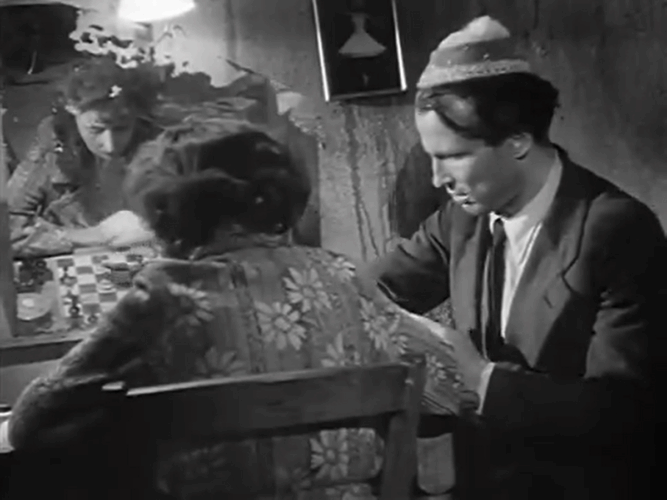
German art from just after the second world war has a very characteristic atmosphere. There is the post-apocalyptic decor, of course, of the proud old cities reduced to rubble. There is the decimated population, malnourished and traumatised. And there is a hazy sense of guilt and senselessness permeating the very air. In literature, Heinrich Boll is probably the biggest exponent of this.1 In cinema, it’s a whole genre. And probably the first entry into that genre is Die Mörder sind unter uns.
It’s a movie from 1946 by Wolfgang Staudte. It deals with a doctor, turned desperate and alcoholic by the war. One evening, we find him in a bar, where a woman is sitting at a chessboard with a mirror in lieu of an opponent.
We get to see the position perfectly clearly. This is it, after the good doctor has decided to insert himself in the game and play Ba5+:2
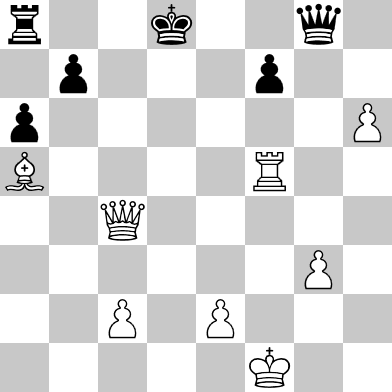 Obviously, black is toast.3 She decides to play b6. The doctor advises her to take that move back, because:
Doctor: Du verlierst dadurch zwei Bauern. [You lose two pawns like that.]
Not doctor: Aber ich rette den König. [But I save the king.]
Had we been a little less desensitised on this blog, that claim would have us howling with laughter. Save the king indeed! It’s mate in three, for God’s sake!4 Understandably, the doctor gets quite irate. Ununderstandably,5 they blame him being drunk, rather than her being an idiot. War-torn Germany really was rather unpleasant.
Realism: 3/5 This is pretty plausible, if we make abstraction of the conversation.
Probable winner: White has a pretty convincing case. And checkmate in three.
1. [No relation to Uwe Boll, as far as I can tell, except that they’re both on the extreme ends of the creative quality spectrum.] ↩
2. [Die vorzüglichen Editoren sind unter uns.] ↩
3. [Toast being edible, he was probably quite popular just after the war.] ↩
4. [I leave the check to the interested reader. Whether black plays b6 or not has no influence on that fact.] ↩
5. [Or derstandably, as it is also known.] ↩